Used and Vintage Musical Equipment
GH Services has a number of vintage and previously enjoyed items for sale.
GH Services is located in the Niagara Region of Canada, near Toronto and the Canada-U.S. border. Owner Greg Holmes is a long-time musician, ready and able to help you with any questions you have. More about GH Services here.
These items are all to be sold "as is", although I may refurbish items as I get around to it. Photos, more decriptions, and other info will come soon - even sooner if you ask for them. Some items are in storage and may take a while to get at. All items use North American power (120V/60Hz) and plugs. Some items may be switchable to work on other power standards.
Prices can be discussed, and are in US dollars unless otherwise noted. Shipping, financing, and related costs are not included.
My motivation for making these items available is simple: I'm not using them, so they should be in the hands of people who can make use of them. These are all private sale items, not part of the business. All items are located in Ontario, Canada.
Hover over the photos to view them full-size. Note: Some of the photos below are not mine; I'm just using them to illustrate the item. I'll replace those photos with my own as time permits.
For more info on some of these items, visit the excellent Vintage Synth Explorer site.
If you are interested in anything here, contact me or call my toll-free order line 1-800-918-9439.
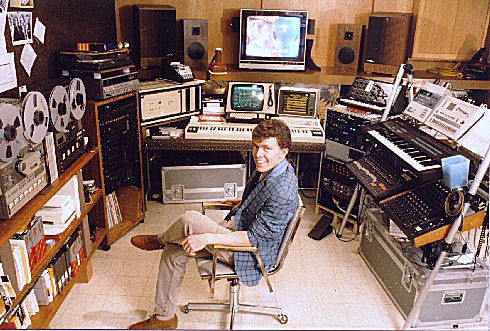
For sale: Fairlight CMI Series IIsn:??????, built 1983Yes - you read that right: I'm parting with this. This was my baby, my heart and soul, and it's not going to just anyone. Note that it is a Series II, not a IIx, so it is based on the 6800 processors, and has no MIDI. I used this CMI when working with Rush, Lee Aaron, Lucasfilm, HBO, etc. If you want this, you need to be able to prove to me that you can care for it and maintain it for as long as I have - and I've had this since it was made in 1983. So think long and hard about whether you're the one... Comes with the grey flightcases shown in the picture, custom-made cables, plus all of the system disks and sound disks - maybe more than 200 8" disks. Also comes with manuals, and extra technical info that normally is not available, including MDOS programming tools and manuals, compilers, assemblers, and other software. I used these tools to create programs for FFT, digital file transfer, etc. Like I said, this will go to someone special, who will carry the torch. New: $30000. Price: $7500 |
||||||||||||||||||||||||||

For sale: Fairlight CMI Series IIsn:??????, built ????This one has a keyboard that was painted black. I got it about 5 years ago from the former Canadian Fairlight dealer. It may be Series I with some upgrades to Series II. I'm not sure if this one is operational, since I never turned it on. At the very least, it would be an excellent source of spare parts. Comes with some of the standard manuals. Price: $4000 |
||||||||||||||||||||||||||
For sale: Fairlight circuit boardssn:??????, built ????These parts are from a Series II that was upgraded to IIx. The process replaces the backplane and some of the logic boards, so that's what I have here. |
||||||||||||||||||||||||||

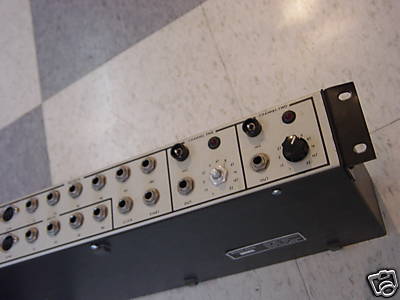
For sale: Garfield Electronics Mini Docsn:??????, built ????CV DIN Tape Sync and time-base convertor. I used it to sync the Fairlight CMI to ... well, whatever needed syncing. You need this if you sync gear such as Roland TB-303, TR-606, TR-808, CR-8000, MC-202, TR-909, or Korg DDM-110, DDM-220, KPR-77, or Linn, Simmons, Oberheim, PPG, etc... Price: $600 |
||||||||||||||||||||||||||
For sale: Hevos 400D bass amplifiersn:#0538/0269A042, built 2006This was my demo model. Very clear-sounding professional bass amplifier with a tube preamp (double triode 12AX7) and a MOSFET class-D power amp, built from top-quality components. There is no pop or thump when turning the unit on or off. One rack unit high (1.75"), with toroidal power transformer. The amplifier produces hardly any heat, so there's no cooling fan.
Price: $950 |
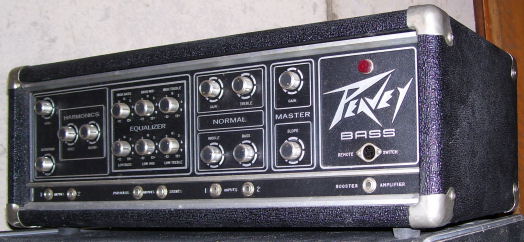
For sale: Peavey Series 400 version B "Bass Power Pak" bass ampsn:7A-025179, built ????210W into 2Ohms. Quite loud enough to match a Marshall Stack and big drum kit (the one on this page). Two distinct channels, one with distortion/fuzz/harmonics and one clean. Each channel has hi and lo inputs, and there are two more inputs that combine these channels in series or parallel. This one has a Slope control (a kind of tone) below the Master - an indicator that it is version B of the amp. Very flexible, I was able to get a Geddy Lee tone out of it, even with the mellow Les Paul Signature bass! With remote footswitch, which I acquired later and never used. Price: $600 |
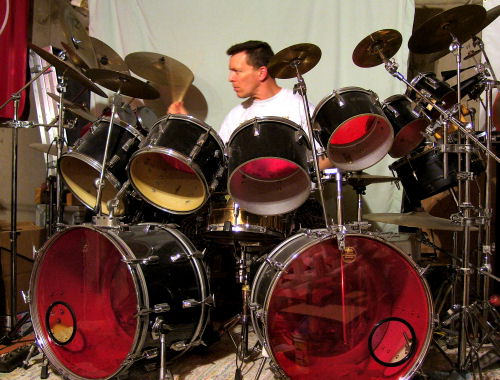
For sale: Pearl, Tama, Ludwig, Zildjian, Sabian Drum Kitsn:??????, built ????This kit is a combination of Pearl and Tama, plus others. Mostly black, currently with red Evans Hydraulic skins. Toms: Pearl 6x5.5, Tama 8x5.5, Tama 10x6.5, Tama 12x8, Pearl 12x8, Pearl 13x9, Pearl 15x12, Ludwig 18x15, Pearl Export 12x10, Pearl Export 13x11. Snares: Ludwig 14x6.5 Brass, Ludwig 14x5. Kicks: Tama 22x16 wood, Pearl 22x16 fibreglass. Tama Octobans: 6x11, 6x12, 6x13.5, 6x15.5. Timbales: Meinl 14x6.5, Meinl 15x6.5. Cymbals: Zildjian 10" crash, Sabian 18" extra thin crash, Zildjian 13" crash, Sabian 20" light ride, Sabian 14" sizzle hi-hats, Sabian 8" splash, Sabian 8" china splash, 11.5" crash, Sabian 8" splash (cracked bell), Zildjian 16" splash, Zildjian 16" china boy high, Zildjian 14" crash, 13" crash, Zildjian 22" ping ride, 13" crash, Zilco 18" crash, 16" Turkish crash. Temple blocks: 6x4.5, 5.5x4, 5x4, 4.5x4, 4x3.5. Bells, etc: LP 8.5x5 cowbell, Meinl 8x5 cowbell, LP 5x4 cowbell, LP 6 + 4.5. bell, glockenspiel. Many stands, clamps, hardware, etc. Cases: Kick drum, percussion, hard snare case, hard cymbal case, soft cymbal case. |
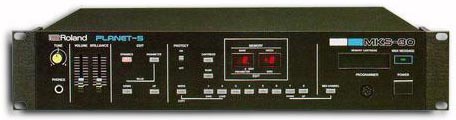
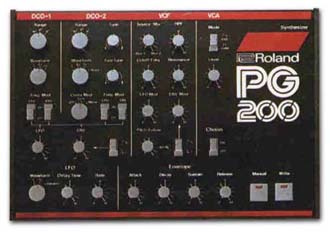
For sale: Roland MKS-30 Planet-S 6-voice analog synthsn:??????, built 1983?The MKS-30 is rack module version of the JX-3P with some enhancements, in essence a velocity-sensitive JX3P with an increased memory. An earlier version, the MKS3, was perhaps the world's first MIDI module, but never made it into production. It is an analog synth with DCO's (digitally controlled oscillators), 6 voice polyphony, it responds to velocity, and has 64 internal & 64 cartridge memory patches. This unit has one voice that "sticks" on, apparently in the release portion of the sound. I think it can be fixed, with the included service/schematic manual. Includes PG-200 programmer surface and M-16C memory cartridge. Price: $950 for both |
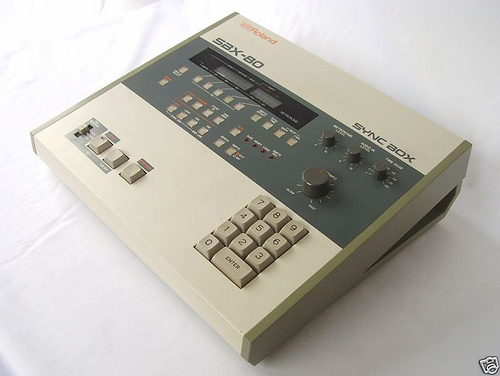

For sale: Roland SBX-80 Sync Boxsn:??????, built ????This is the cadillac of synchronizers. It reads and generates timecode, plus provides MIDI clock. It stores a tempo map internally. The method: 1) Record SMPTE and a 1/4 note click track (which can vary in tempo) to your tape. 2) Feed the SMPTE and click into the SBX-80, which will memorize the relationship between the two. 3) The click track can be erased, because it is now stored in the SBX-80. (You can later edit individual beats, if you want.) 4) Subsequently, you can start the tape anywhere, and the SBX-80 will emit the matching MIDI song position info and tempo. This method will allow you to sync up to already recorded tracks. With manuals. List price was $1195.00 Price: $500 |
For sale: Roland DEP-5 digital effects processorsn:746328, built ????This is open on my workbench right now, and I can't remember why. |
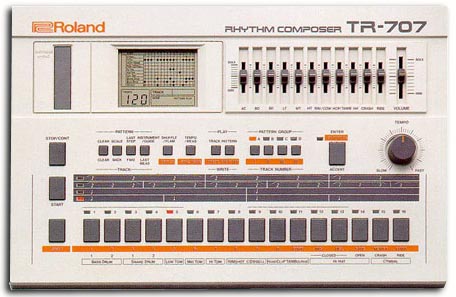
For sale: Roland TR-707 drum machinesn:547837, built 1985?Roland's first all-digital drum machine, with 8-bit and 6-bit (cymbals) samples. 15 sounds: kick 1, kick 2, snare 1, snare 2, low tom, mid tom, high tom, rim-shot, cow bell, hand clap, tambourine, open and closed high-hat, crash/ride cymbals. You can re-map the sounds to different MIDI note numbers - something that we now take for granted, but which was radical at the time. MIDI IN/OUT, DIN SYNC IN/OUT, TRIG OUT. I'll soon post a soundfile. Price: $800 |

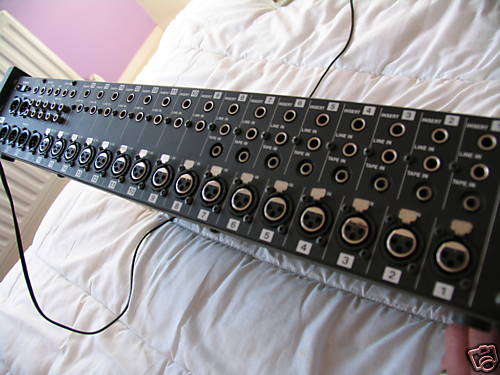
For sale: TASCAM M-216 analog mixersn:??????, built 1986?Many believe that this is easily the best budget console TASCAM ever made, and that it runs circles around anything like the newer Behringer, Alesis, Mackie, and TASCAM outsourced gear. It’s also a hackers dream if you’re into modifying, with discrete components and a modular design. It’s very well made with a separate card for each channel. Whatever features it doesn’t have you can add. 16x4x2. Dimensions 26" wide X 17" deep X 2" high front and 5" high rear. Three-prong grounded power cord. Mic pre-amps have a decent dynamic range, but no phantom power since this was designed as a home-studio mixer. EQ at 100Hz, sweepable mid, and 10KHz. Has one mono effects bus, and one "foldback" buss, which can be used as a second effects bus. It has stereo effects returns, and direct feeds from both buses to the output channels. It has two AUX busses: one pre-fader and one post. The first 8 channels have an additional RCA line-level connector, that you can use with a tape recorder, or use for other inputs. This makes the board very useful for radio production rooms, where you may want to plug some consumer-type equipment in. With 4 analog meters. This mixer works well with the Tascam 38 reel-to-reel tape machine. This unit is not fully functional. The meters light up and the headphone output is working, but the signal paths are silent. I'm assuming that one of the voltage rails is not working, because only one of the 4 fuses blows. I never got around to fixing it, since I did not need to use the mixer. A tinkerer with some tools and some knowledge could get this going. With original box, packing, manual, etc. New: $1800 approx. Price: $650 |
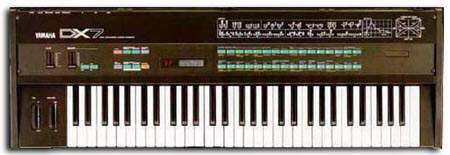
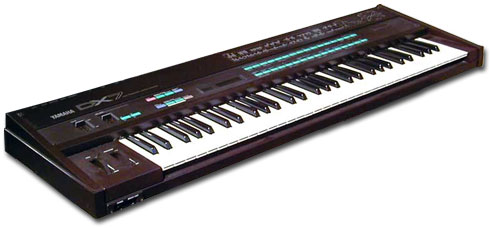
For sale: Yamaha DX-7 keyboardsn:??????, built ????This is not my original mint-condition DX-7 which was brought back from Japan in 1985. That one was stolen from my old appartment years ago. This one was a replacement, which I bought used. It has some cosmetic wear (I'll take some pics of that), since it had been at gigs before I got it. Includes 5 (or more) original Yamaha factory ROM sound cartridges with various sounds, plus a RAM cartridge. Needs a new backup battery. Price: $700 |
For sale: Yamaha DX-7 II-FD keyboardsn:??????, built ????Includes the E! ROM upgrade, with manuals. Includes RAM cartridge. Needs a new backup battery. Price: $750 |

For sale: Yamaha REV 7 digital reverbsn:3536, built ????A very classy digital sounding reverb. Balanced 1/4" ins and outs, plus XLR. Excellent condition, with wired remote control, original box, and manuals. Price: $550 |

For sale: Yamaha TX816 rack with MRF8 and eight TF1 modulessn:2209, built 1985?The TX816 is a rack unit with eight TF1 modules. A TF1 module is a DX7 on a single circuit board with almost no front panel controls. The TX816 allows you to easily carry around up to eight DX7s! Each TF1 module consists of a 16-voice, 6-operator digital FM synth engine, with an indepednent audio out (XLR) and MIDI I/O. Each module can be programmed via MIDI. There is also one global MIDI in/out port on the TX816. This unit probably needs new 3V lithium (cr2032) backup batteries (normally last about 5 years), and the ones with the leads already attached would be best. I never changed the factory presets, so they may be still fine (or at least re-loadable from here). Includes the original boxes and manuals. Original cost approx $4000. Price: $1200 |
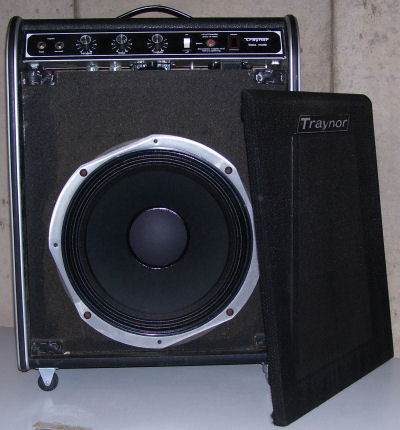
For sale: Yorkville Sound Traynor YBA-2B Bass Matesn:8022780, built 1978-02This bass amp uses a 15" driver and 4 tubes (two each of 12AX7A and 6BQ5). Built-in circuit breaker. Hand-made point-to-point wired, so it can be modded. Schematics may be pasted inside the chassis, but are also available here. The tone has been compared to vintage tube guitar amps, e.g. Jimmy Page. I used it as a bass amp for practicing. The original driver was stated as EIA code 7370, may have been a Marsland, but it was replaced in 2001 with a Peavy Scorpion Plus 15" Kevlar impregnated (rated 200W+). I also added wheels - two fixed, two free wheeling. It's trimmed with chrome & rubber bumper stripping, which was dropped from Traynor production around the year this one was built. Traynor made tube amps up until about 1980 when tube amp production ceased for a couple of decades because solid-state became more popular. Can be used for guitar or bass. Probably needs new a new tube or two, since it has not been used for a number of years. Weighs about 45lbs. Price: $450 From "Yorkville Sound History - 1963 to 1991" by Mike Holman: 1969: Pete Traynor had his hands full in the latter half of 1969 [doing concert sound], so it comes as no surprise that new consumer products were a tad sparse. However a few were developed including the YBA-2B Bass Mate (25 Watts sine-wave rms @ 8 Ohms), a slimmed-down, closed-back replacement for the cube-shaped YBA-2 with 5 Watts more power and with controls - volume, bass & treble - located on the front rather than at the back. |
For sale: Yorkville Sound Traynor Mono Block II bass ampsn:9110193, built ????325 @ 2 ohms and 250 @ 4 ohms. Those are "Traynor watts" (conservatively rated, usually at RMS not peak) so the amp was very loud. This was my main amp, since it was clean and loud (compared to the Peavey 400, which was loud with a distorted edge). Solid state, but as close to tube sound as you can get. All the wiring is hand soldered and the components are top notch. This amp is the version 1.1, with the 2N3773 transistors in the power amp section. Schematic (on page 2). This amp needs some repair in the power amp section. The power supply, preamp, and EQ works with output going to the "preamp out" socket on the back panel, but the right side of the amp is cold to the touch - that side is where the thermal breaker and three of the six output transistors are located internally. Price: $400 From "Yorkville Sound History - 1963 to 1991" by Mike Holman: 1972: Glen Moffatt provided the chassis design and cosmetics for Pete’s pet project. This was to be a very high-powered, solid-state bass amp with massive, cast aluminum end panels to provide heatsinking for the output transistors. Glen’s cosmetic model was so good-looking it was displayed at trade shows starting in 1972, even though Pete was still trying to finalize the electronics. Over a year and four trade shows would pass before the unit was more than an empty shell thus earning it the nickname “cardboard amp” in certain circles. But the look of it would prove to be influential later on (so would the amp). 1973: What do you call the most powerful solid-state bass amp in the world? A meeting in the Spring of 1973 netted many suggestions - even “Beavertone” was jokingly put forth by some misguided Canadian patriot (actually a single Beavertone prototype was made as a joke with a strange looking beaver on the front panel). At last someone said “Mono Block” and that was applauded by all. One of the prototypes was given the 2nd floor drop test after which a bottom plate three sixteenths of an inch thick(!) was specified to prevent the massive transformer from warping it under drop test conditions, however no other changes were necessary. In June the working (Beavertone) prototype was taken on tour by the Greaseball Boogie Band and survived a gruelling six weeks on the road. One or two competitor’s products claimed to put out 250 Watts or more into 2 Ohms but they shut down due to overheating. The Mono Block B (B for bass - a guitar model was being considered but never materialized) could run into 2 Ohms all night at full volume with no problems. Best of all, it put out 325 Watts sine-wave into that load, another Yorkville “first”. This was Pete Traynor’s baby, the bass head he’d been working on for over a year (see 1972) and it lived up to everyone’s expectations. There were dual inputs, volume, bass, low mid, high mid and treble controls plus a master volume. Preamp out and power amp in jacks were located on the back panel so that you could patch-in an EQ-1 or even “slave” the amp for PA use. With all that cast aluminum on the ends and slabs of aluminum everywhere else it really did look like a high-tech “block”. The Mono Block remained a popular product for several years being updated to the Mono Block II in 1977. This version added a five-band graphic equalizer at the expense of only one of the old tone controls - not a bad deal considering that the price remained unchanged. |
For sale: Magazines: Dr.Dobb's Journal (1987-1996), Computer Language (1986-1993), BYTE (1984-1997), A.I. Magazine, Databased Advisor, Windows Magazine, Model Airplane News, Model Builder, RC Modeler, Keyboard Magazine, Bass Player Magazine, Electronics Today, Electronic Musician, Polyphony, Cinefantastique, STart, ST-Log, IEEE Spectrum, Publish, and othersI have many back issues of these magazines - actual paper magazines, remember those? They are approximately 1980 to 1996, although it varies. Airplane mags are earlier, reaching back into the 1980s, and possibly 1970s. Generally continuous series, with no gaps (since I had subscriptions). Most in excellent condition. Upon request, I can identify which issues I have. I doubt I'm willing to sell individual issues - probably only larger quantities. I'm moving and want to find good homes for them all. |
For sale: Atari 1040STsn:??????, built ????Computer, with external hard drive, printer, other peripherals, and many, many disks and programs. |
For sale: Computer components: network cards, graphics card, serial/parallel, and othersMost for PC: ISA, EISA, or PCI interfaces. Also some RAM for older PCs. Plus an Alex vidotex terminal.Too much to list individually, but I suppose that I will eventually... |
For sale: Apple Macintosh computersIncluding Color Mac, Classic Mac, some with hard drives, peripherals, etc. |





_new_hue.svg_x65t.png)